I received a sample for this review/feature. Opinions expressed are my own.
Check out the exciting new tool from Born Free USA, to support parents interested in teaching their children about wildlife. What Elephants Like, is a website, video, book, and more, that offers a fun, kid-friendly, non-graphic, way to have a meaningful conversation about animal welfare ? the plight of elephants.? Future conservationists ? kids ? can learn early about the importance of keeping wildlife in the wild! My oldest is especially interested in protecting wildlife so this website and book are exactly the kind of thing I like to show her so she can learn more.

What Elephants Like
By Adam M. Roberts, CEO of Born Free USA and the Born Free Foundation
Beautiful gentle giants. Elephants are not meant to be held captive. They are not meant to perform. They are not meant to balance on balls or barrels. They are not meant to stand on their heads. They are not meant to give massages, or play basketball, or catch apples in their mouths.
They are meant to be in the wild with their grandmothers, mothers, aunts, and cousins, free to live as nature intends, doing what they choose to do, each and every day.
It is important for parents today to talk with their children about wildlife conservation and animal welfare. It never needs to be graphic or scary, as you can see at the new website, www.whatelephantslike.org! As a father of an 11-year-old, I know firsthand how open minded and inquisitive young children are, and how much they innately love animals and want to do what’s right for them.
Elephants today are suffering tremendously and populations are dwindling fast. Our kids and our grandkids can make a difference. But, we have to start the conversation early and not be afraid. Make it fascinating and upbeat, and use the proper language and tools. Our children are future conservationists and it is critical that we speak with them about wildlife and how these beautiful animals deserve to be free.
To get started, explain to your children that there are three elephant species on our planet: African savannah, African forest, and Asian.
African elephants: Two species exist in Africa: the Savannah and the forest. A male African elephant can measure 11 feet long, 13 feet high, and weigh six tons?as much as five cars or 80 people! Unfortunately, due to various human activities, the wild population of African elephants has fallen from 10 million in 1900, to 1.3 million in 1979, to about 420,000 today. Born Free USA works hard to reverse that trend. By becoming more aware of the issues, you can help elephants, too.
Asian elephants: Asian elephants are a bit smaller than their African relatives, but they are ideally suited for the forest environments they typically inhabit. Asian elephants are mainly threatened by loss of this habitat due to competition with people for land. The Asian elephant has a long association with humans and is domesticated in certain countries. Sadly, elephant calves are often taken from the wild to be trained to carry logs, kept in temples, and used for elephant-back safaris.
Fun Facts about Elephants
- Elephants live in family groups that combine to form herds.
- Elephant family groups are matriarchal, which means that one of the older females is the leader.
- Elephants are very social. They like to hang out with other elephants and communicate in various ways, from loud trumpeting to low rumbling (so low that humans can’t even hear it)?that other elephants can hear more than two miles away!
- Elephants use their trunks for a lot of different things, including reaching for food, blowing water onto their backs to cool off, and even as a snorkel for breathing while under water.
- Elephants can live up to 70 years in the wild.
- Elephants are happier in the wild. They should live freely. But, they are at risk of being captured for circuses and zoos, or being killed by poachers for their ivory tusks.
- They are herbivores, meaning they only eat plants like grass, fruit, bark, and twigs.
- They use their tusks to dig and find water, clear pathways through the forest, shake fruit out of trees, and make scratches on tree trunks to mark their territory.
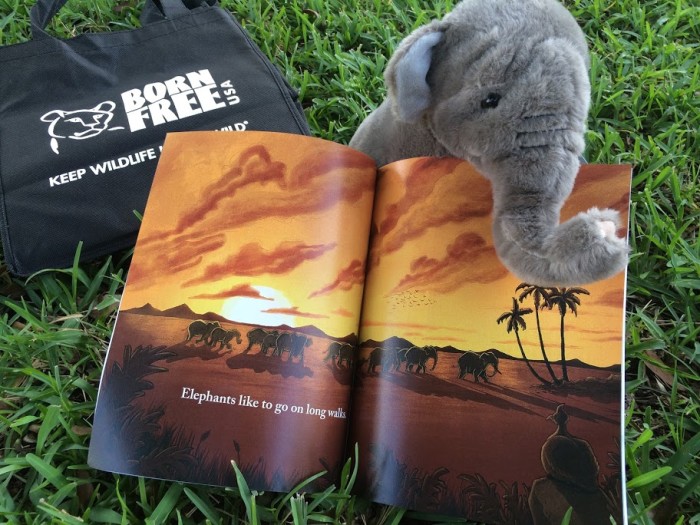
Be sure to take a look at the new book, What Elephants Like (available as a free download or e-book at www.whatelephantslike.org or for purchase at www.createspace.com/4856106). A sensitive, beautiful story to read together and help communicate the message of animal suffering without getting into any graphic details. It appropriately entertains and enlightens kids of all ages. I hope both my girls learn to appreciate all animals and reading about them is one great way to do that.
Connect: You can connect with Born Free USA on Facebook and @BornFreeUSA on Twitter.

